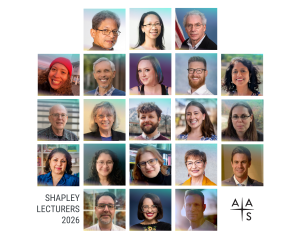
The American Astronomical Society (AAS) has selected 21 astronomers who will form the 2026 cohort of AAS Shapley Visiting Lecturers. These lecturers will visit a number of schools and community institutions across the US to share their science, inspire wonder about the universe, and build lasting connections to these communities.
Through the AAS Shapley Visiting Lectures Program, founded in 1958, the AAS financially and logistically supports the travel of a selected group of astronomers each year to US colleges or universities to give a series of astronomy-themed lectures to the institutes' students, coupled with a public talk to the local community.
This year's 21 astronomers will visit destinations in 17 US states covering a wide swath of the country. Each Shapley Lecturer will deliver a highly accessible presentation about their scientific work to public audiences at each destination. Each visit will also include 2–3 days of local engagement with schools and community organizations, creating opportunities for students and members of the public to meet a scientist.
The 21 AAS Shapley Visiting Lecturers and their destinations in 2026 are listed below.
- Kavitha Arur (NASA & University of Maryland, Baltimore County): Berea College in Berea, Kentucky
- Brad Newton Barlow (University of North Carolina at Chapel Hill): Fontana J8 School District and Yerkes Observatory, Fontana, Wisconsin
- Antara R. Basu-Zych (NASA & University of Maryland, Baltimore County): Rowan College at Burlington County in Mount Laurel, New Jersey
- Allyson Bieryla (Harvard University): SUNY Niagara Community College in Sanborn, New York
- Michael Cushing (University of Toledo): Clinton Community School District in Clinton, Wisconsin, and New Trier High School in Winnetka, Illinois
- Ryan French (University of Colorado Boulder): Cedar Amateur Astronomers (CAA) in Cedar Rapids, Iowa
- Steffani Grondin (University of California, San Diego): Boise State University in Boise, Idaho
- Puragra (Raja) GuhaThakurta (University of California, Santa Cruz): Clackamas Community College in Oregon City, Oregon
- Anjali Gupta (Columbus State Community College): Russia Local School in Russia, Ohio
- Heidi B. Hammel (AURA): Morgan County Observatory Foundation in Berkeley Springs, West Virginia
- Quyen Hart (Space Telescope Science Institute): The Wilderness Center in Wilmot, Ohio
- Isabel Hawkins (Exploratorium): City College of San Francisco in San Francisco, California
Cameron Hummels (Caltech): Ventura College in Ventura, California
- Chris Impey (University of Arizona): Scottsdale Community College in Scottsdale, Arizona
- Anna D. Kapinska (National Radio Astronomy Observatory): Clark Planetarium in Salt Lake City, Utah
- David Leisawitz (NASA Goddard Space Flight Center): University of Nebraska at Kearney in Kearney, Nebraska
- Teresa Paneque-Carreño (University of Michigan): Jackson College in Jackson, Michigan
- Justin Robinson (Georgia State University): Chapel Hill Public Library in Chapel Hill, North Carolina
- Katy Rodriguez Wimberly (California State University, San Bernardino): Crafton Hills College in Yucaipa, California
- Angela Speck (University of Texas at San Antonio): Astronomical Society of East Texas in Tyler, Texas
- Joel Weisberg (Carleton College): Shiras Planetarium of Marquette Area Public Schools in Marquette, Michigan
These 21 lecturers follow in the footsteps of many past Shapley Lecturers, including 12 who led the way in revitalizing the program in 2024–2025. Over 140 astronomers, and many schools and community institutions, responded to AAS’s call for applications to the program in Fall 2025, revealing widespread interest in public engagement programs like the Shapley Lectures.
The AAS’s Shapley Lecture program dates back to 1958 and was dedicated to the memory of eminent astronomer and former AAS President Harlow Shapley after his passing in 1972. For many years, the AAS has financially supported the travel of its visiting lecturers through an endowed fund built through private charitable donations. The program entered a hiatus in 2020–2023 during the height of the COVID-19 pandemic, but it was relaunched as a collaborative pilot with the NASA Community College Network and SETI Institute in 2024–2025; the 2026 program now represents its full re-emergence to the AAS community.